Pokémon GO
The map is real
Hundreds of millions of people walked to a specific physical place because something was waiting there. The behaviour is proven.

 Award entry
 Point your phone at the street, and the street answers. Gamify Dubai turns the world's most ambitious city into a place worth playing, where what you collect is genuinely yours.
A concept documented in May 2023, running on infrastructure that is live today. Built in Dubai by bonuz.
The idea
Three of the biggest games ever made each taught the world one piece of it. Gamify Dubai is the merge, except the map is the actual city you are standing in.
Pokémon GO
Hundreds of millions of people walked to a specific physical place because something was waiting there. The behaviour is proven.
GTA
Turn left instead of right and something different happens. No script, no queue, no menu to read first.
World of Warcraft
Somebody needs something done. You go, you do it, you come back with something to show for it.
The difference: in every one of those games, you owned nothing you earned. Here, what you collect sits in your own wallet, on your own device. If bonuz vanished tomorrow it would still be yours.
Live today
bonuz LIFE mode went live in the public app in August 2026. Anyone can download it and stand on a real street with it this afternoon. These are captures from the running build, and app.bonuz.xyz is where it is all happening.
Three things do most of the work. A card hangs over a place with its real distance. A beam of light rises from anything waiting to be picked up. A cone points the way you would point at a friend across a square, and the radar shows what is behind you.
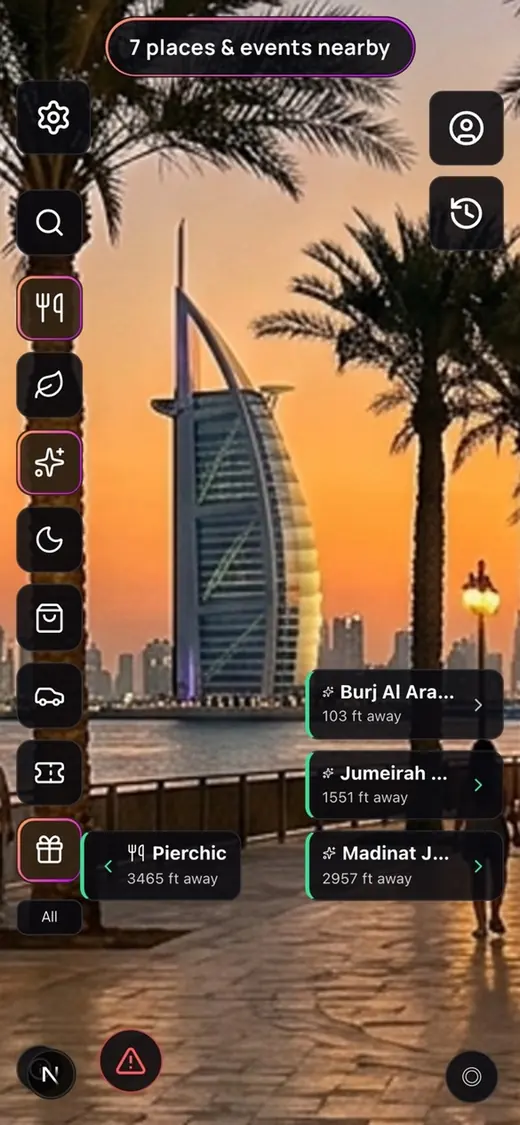
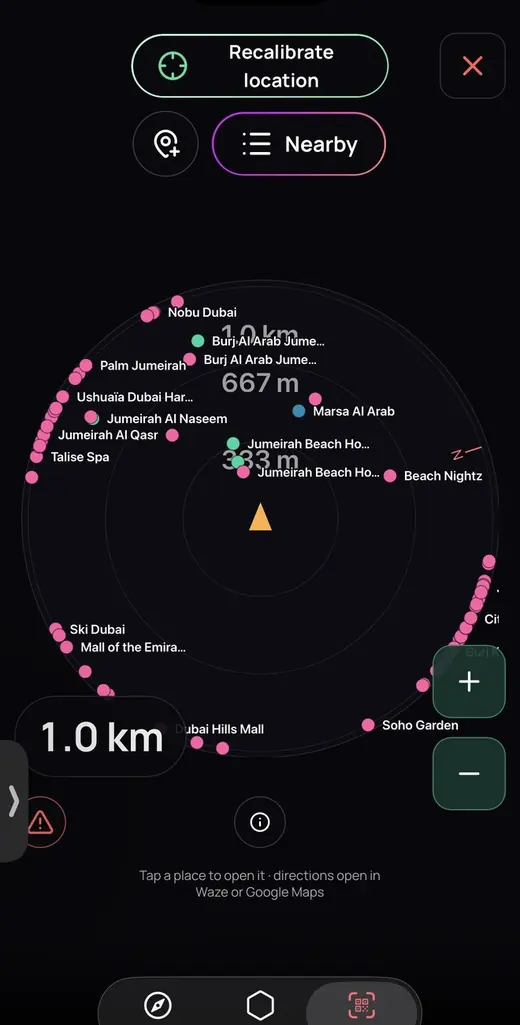
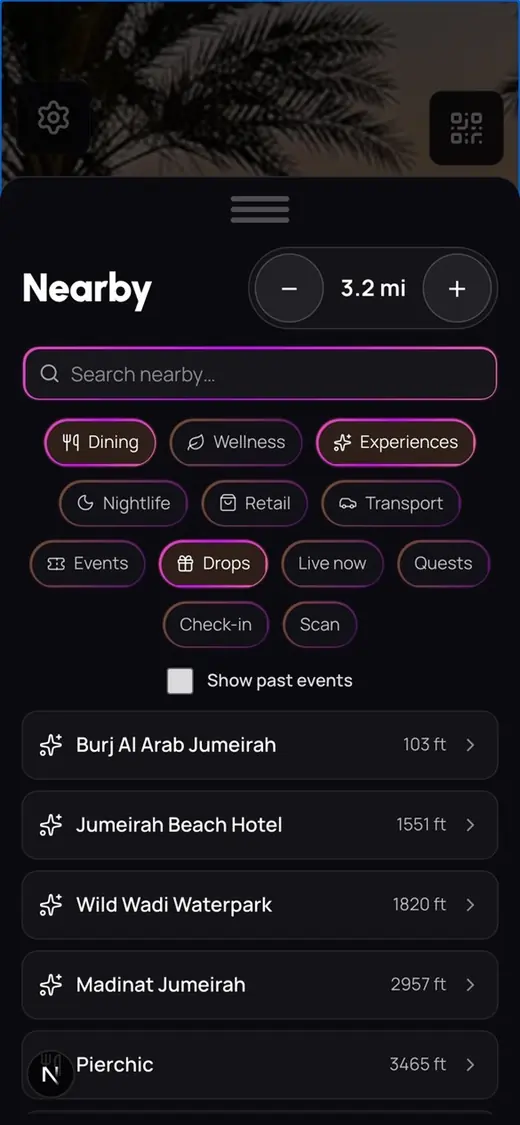
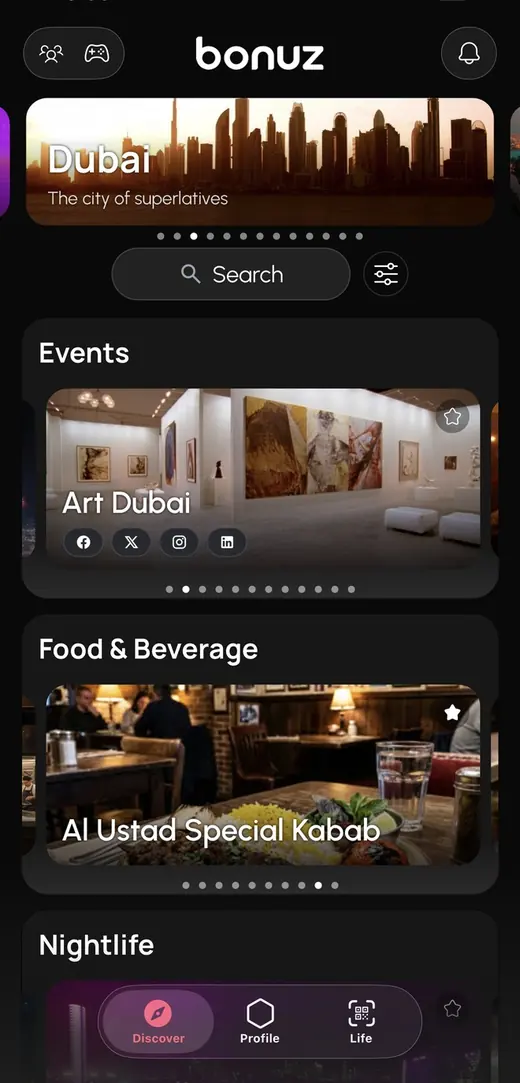
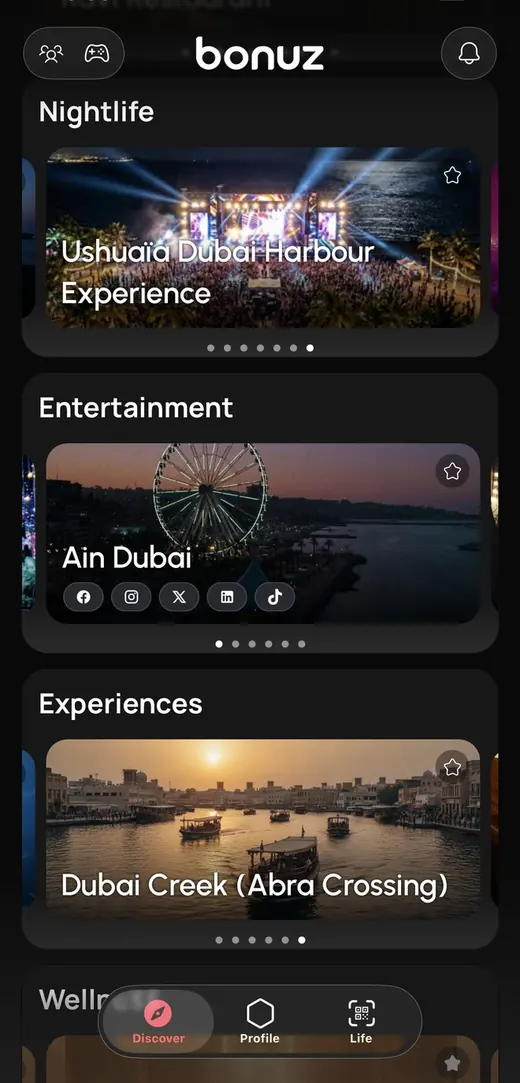
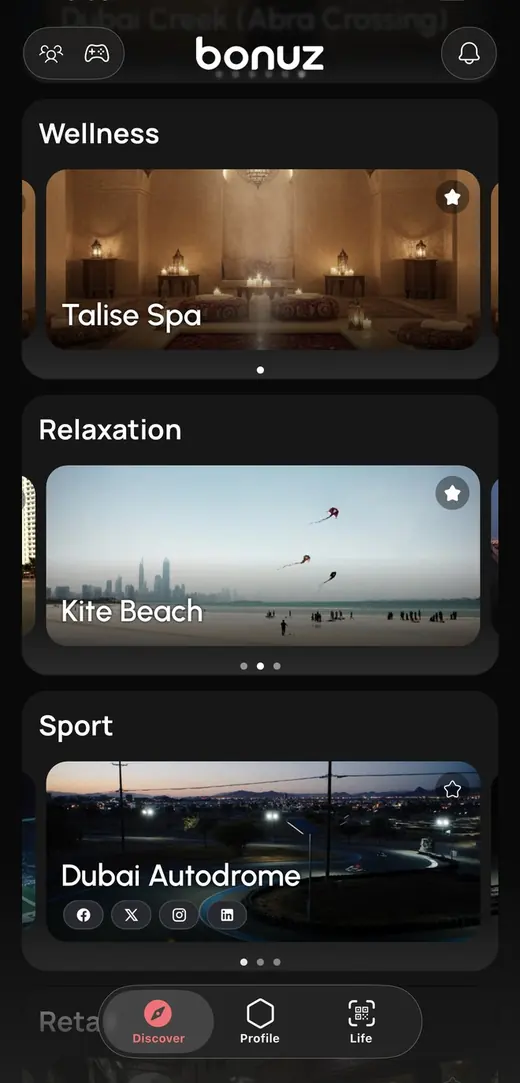
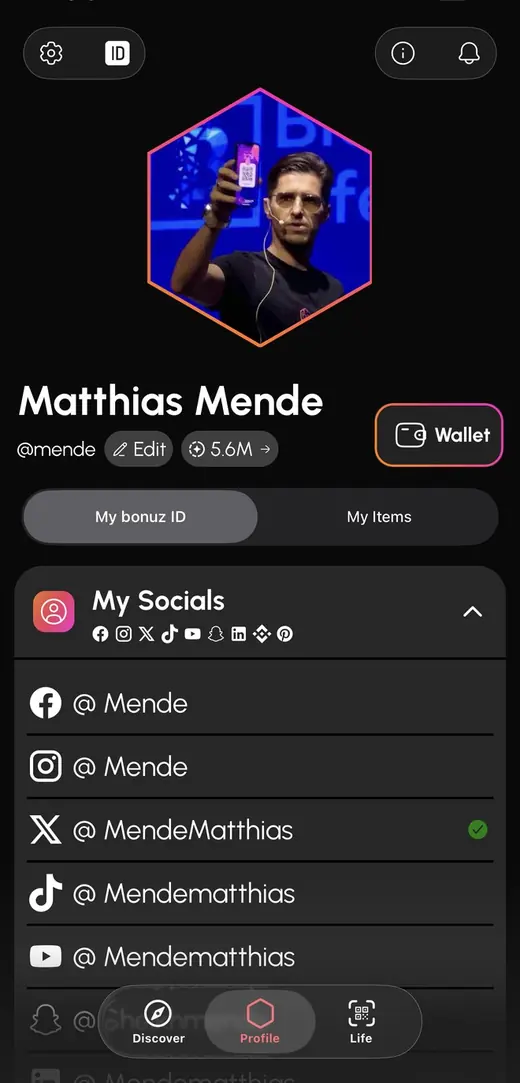
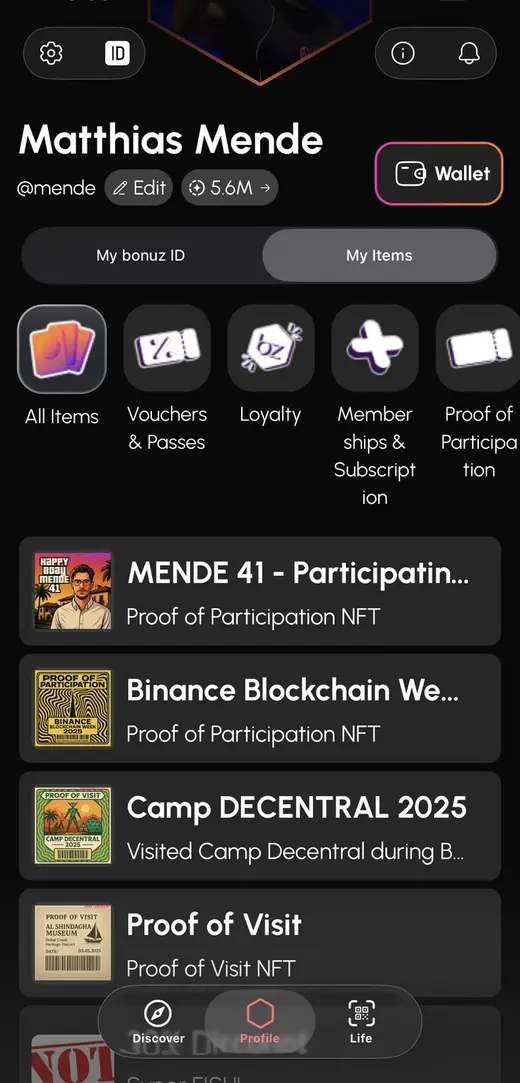
Verified venues live in Dubai, Abu Dhabi, Sharjah and Al Ain, plus Berlin, Los Angeles, Miami and New York. Every UAE coordinate is checked against geocoders rather than eyeballed on a map, because when a navigation cone points at a building, being five hundred metres out is not a rounding error. Figures as at August 2026.
In the street
A screenshot is a flat rectangle. The thing itself happens at arm’s length, on a real pavement, in the middle of an ordinary evening. Same three mechanics as above, shown at the size a person actually meets them.


Straight answer on these six: they are rendered illustrations, not screen recordings, because no phone capture can show you the street and the screen at once. The eight screens in the section above are captures from the live build, and where the two ever disagree, the screens are the truth. The pin, the path and the beam are all real mechanics running in LIFE mode today.
How it plays
Every quest is the same three things. Somebody marks a real place, somebody proves they were there and did the thing, and they are paid for it. Only who sets the quest changes.
For visitors
Land, claim a pass, and the city lays itself out as something worth walking. Heritage stops stop being footnotes. The souk, the museum and the lane at the far end all become somewhere to go.
For residents
People who live here do not arrive at a terminal. Their way in is the city's own calendar: a season, a district challenge, a weekend. A resident on a year-long streak is worth more to a venue than a visitor passing through once.
For business
A cafe cannot outbid a delivery platform for search advertising. It can hang something in the air outside its own door, for the people already walking down its street, priced at about a coffee.
For the city
Clean-up and prosperity quests put small civic work in the hands of the people already standing there, verified by presence and paid on proof. Built and specified. Never yet run for a funder.

The honest part
A layer that overclaims does not get a second launch. So here is the line, drawn by us, before anybody has to ask.
The app in both stores. LIFE mode. 27 products. The brand dashboard running memberships, loyalty, communities and events for real businesses. Verified venues across four UAE cities. Self-custody, audited.
Server-side photo proof for completed tasks. Instant payout on claim. Partner self-service placement. The first sky inventory. Specified and in build, not shipped.
No sponsored campaign has ever run on bonuz. No clean-up or prosperity quest has ever run live for any funder anywhere. Gamify Dubai is a documented concept on live infrastructure. It is not a programme that has happened.
GPS is weaker indoors, in basements, in deep malls and between towers, and a precise marker over an exact doorway is not achievable in those places. The system degrades on purpose rather than by accident: where positioning is weak, the same quest still works through a scan at the door, a photograph, or a check-in confirmed by the venue. A proof has more than one form.
Provenance
March 2023
gamifydubai.com registered, two months before the concept paper was written.
May 2023
The Gamify Dubai campaign paper documented internally, with challenge segments, prize architecture and a go-to-market plan.
August 2026
bonuz LIFE mode live in the public app. The surface the concept always needed now exists, in production, on ordinary phones.
Between those dates there is no shortcut. There are years of building, most of it unglamorous, all of it in Dubai.
Dubai-it 2026
On 17 June 2026 Dubai gave its way of working a name. Dubai-it: we say what we do, and we do what we say. The award behind it looks for three things. This page is bonuz's entry, filed 10 September 2026, and this is how it answers each of them.
Bold idea
Written down in May 2023, before the phrase existed: every street a level, every venue a checkpoint, and what you collect yours to keep, in your own wallet.
Record time
LIFE mode reached the public app in August 2026 and runs on ordinary phones today. The film that went in with the entry was released the same week the entry was filed. Made in Dubai, by a Dubai company.
Extraordinary achievement
What we put on the table: a self-custody layer audited 10/10 by Hacken, 24 languages including Arabic, verified venues in four UAE cities, and a proof of visit that belongs to the person, not the platform.
Dubai was already the greatest open world ever built. It was just missing the game engine. So we built it.
That is the line the film opens with. Ninety seconds, one real phone, one real Dubai street. Landmarks introduce themselves. A drop sits four hundred metres away and you walk to it. A cafe hands you something for showing up. And what you pick up is yours.
An entry, not a result. Filed 10 September 2026, under review, nothing awarded. The ledger above still applies to every word on this page.
 Watch on Instagram
Reading archive
A fair question, and we would rather point at other people's evidence than our own. Location-based play has been studied for a decade. Here is what the record says, including the parts that argue against us.
The behaviour at the centre of this idea is not a hypothesis. It was demonstrated at global scale and then sold: in 2025 the games division behind Pokémon GO was acquired for $3.5 billion.
On the commercial side, research presented at CHI 2023 examined location-based advertising inside Pokémon GO, where chains negotiated to turn their branches into in-game points of interest. A later study in ACM Games: Research and Practice interviewed 35 small business owners who took part in Niantic's sponsored-location programme during 2021, which is the closest existing analogue to what a district campaign would ask of a cafe.
Building Positively Affective Location-Based Advertising: A Study of Pokémon GO Players, CHI 2023, doi 10.1145/3544548.3580939 · Pokémon GO as an Advertising Platform, Games: Research and Practice, doi 10.1145/3641509
The most quoted figure comes from the McDonald's Japan sponsorship, where research from GLOBIS University reported roughly 1.5 to 2 million daily visits across about 3,000 locations and an estimated 22% sales increase during the campaign. Niantic separately reported that its 2024 GO Fest events across three cities produced around $200 million of economic impact including $61 million in tax revenue.
The honest caveat. Those are a single global franchise and a handful of ticketed mega-events, at the peak of a cultural phenomenon. They are evidence that the mechanic can move bodies and money. They are not evidence that a district campaign in Dubai would reproduce them, and we do not model our own projections on them.
Figures as reported by GLOBIS University and by Niantic. Third-party reporting, not independently verified by bonuz.
The same literature is clear about the failure modes, and they shaped how this is built. Location games create safety and trespass problems when anyone can place anything anywhere, which is why the airspace above a venue belongs to that venue here, enforced in the database rather than in a policy document. They create spoofing and fake-presence problems, which is why proof of presence matters more to us than a check-in button. And sponsored placement can read as surveillance, which is why a self-custodial architecture has nowhere to keep a behavioural profile even if someone wanted to sell one.
The small-business research is also blunt that results were uneven: some operators saw real traffic, others saw very little. Proximity is an advantage, not a guarantee.
Every study above measures a world where the player owned nothing they collected. When the servers changed, so did everything earned. Nobody has run the version where a visitor keeps what they earned in a wallet the operator cannot reach into, and where a city can prove a person was somewhere without building a database of everywhere they have been.
That is the open question, and we are not pretending it is closed. It is why the proposal is one district and one season rather than a city and a decade, and why the honesty ledger above exists.
This archive will grow. If you have research that contradicts any of the above, we would genuinely like to read it: ir@bonuz.market.
The long view
That is the end of the road, not the beginning of it. Today the layer covers verified venues in four UAE cities and one district would be the honest first test. But this is the shape of the thing, and it is worth being clear about what we are building toward.
Illustration.
What happens next
This does not need the whole city to begin. It needs one district with a willing partner, one season, and a venue list. Everything else is already built and already running.

Dubai, first light. One marker, on one building, on one street. Illustration.